|
Steve Steinbock has graciously reviewed God and the Great Detective at EQMM's "The Jury Box" and given it five stars. Check out his review here.
0 Comments
I'm late posting this here, but I was honored to be asked to contribute a piece to Ellery Queen: A Website on Deduction as a West 87th Street Irregular. You can read it here.
A Website on Deduction is the best resource for information about Ellery Queen on the web and it has been for decades. I'm proud to be featured on the site. I am currently on vacation and so unable to put together much of a post about the current kerfuffle about Jason Aldean and “Try That in a Small Town.” I’ve read the lyrics and they’re bad. I’ve heard that the video is worse. If I had time I would weigh in with the hottest of takes, since this is one of the places where I can say definitively that I’m kind of an expert. But alas. I’m going to confine myself to a reading list—one nonfiction and four fiction—that serve as effective counter-programming to Aldean’s whole thing.
This is an important point, so I’ll put it here at the beginning: the small town is symbolically America. It always has been; this is a point both Poll and I make in our respective studies. Historically, writers and artists have used the small town as a symbolic space to probe the complexities and contradictions of America. These authors don’t idolize small towns; they use them as tools of critique. And often they expose nasty things there: violence, racism, misogyny. Jason Aldean does the same thing. He sees the small town as a site of violence. But rather than suggesting that this violence is a symptom of something deeply wrong with America, he idolizes it. He pumps it up. For Jason Aldean and his ilk, it is fundamentally good and right that small towns murder people unlike them. By extension, his ideal America is murderous and violent. This is small-town America as imagined by Pennywise. That’s what I find troubling about this horribly-written song. Not only that he’s advocating violence but that he’s looking at a genre that has historically seen violence and deplored it and saying “This is what America should be.” I don’t want to say that’s new, but it’s a striking perversion of the formula. Anyway, I’ve a plane to catch so I won’t say more now. Read these books. Imagine a better world. Unranked: Main Street and Empire by Ryan Poll. This is a central book to all my thinking on small-town literature. I don’t actually agree with a lot of what Poll says here but it’s all said so well and so convincingly that I can’t not recommend it. Poll essentially suggests that the small town works as an imaginary space or covering that allows American imperialism to continue undetected even by the citizens of that empire. Kings Row by Henry Bellamann I consider this the first of what might be called the definitive midcentury small town trilogy (unofficial). Bellamann dives beneath the surface of an idyllic small town to expose rot, corruption, murder, and incest. It’s an absolutely bonkers novel that was too weird for Hollywood; the 1942 movie is a pale reflection of this book’s lurid glories. Peyton Place by Grace Metalious. The second volume in my unofficial trilogy, this book is Bellamann in a feminine vein. Indeed, the books are so close that you could make a case that Metalious is simply rewriting Bellamann. Be that as it may, this is a book worth visiting and revisiting, particularly for the bold way it foregrounds both women’s sexual desires and the dangers of a world in which a woman’s body and reproduction are not her own. ‘Salem’s Lot by Stephen King. Tighter and better-paced than it’s bulkier younger sibling IT, this is the third book in the midcentury trilogy. On the surface it seems to conform to the dreariest academic truisms about small-town fiction: that the community is pure and any corruption comes from without. However, King is clear that the external evil (vampires) only arrives because of a preexisting internal evil. This is something he’ll explore more in IT, which is a massive and sloppy novel that absolutely deserves to be read. Strange Fruit by Lillian Smith A novel about a lynching and about the tangled lives of racially separated people in a small town. The ways in which love and violence interact are explored. Worth reading for that alone and for the way Smith exposes the ways even “nice” people can show nasty streaks of cowardice and racism. And, of course, there’s my book: American Small-Town Fiction, 1940-1960. Over at Arts and Faith I had the privilege of writing a blurb for F for Fake, which ranked tenth in the "Spiritually Significant Documentaries" list. It's a good list, and one I'm happy to have voted on. I'm also reasonably happy with the blurb, with one caveat: my actual write-up was significantly longer, and what I eventually submitted was a radical cut-down of the two thousand or so words I wrote. That's not a problem; a blurb is a blurb and a rambling ten-part essay is a rambling ten-part essay. But I figured it would be a shame not to put the whole thing up somewhere. So I'm putting it here, along with a very bad photoshop job that I threw together in about twenty minutes using Gimp. Enjoy. 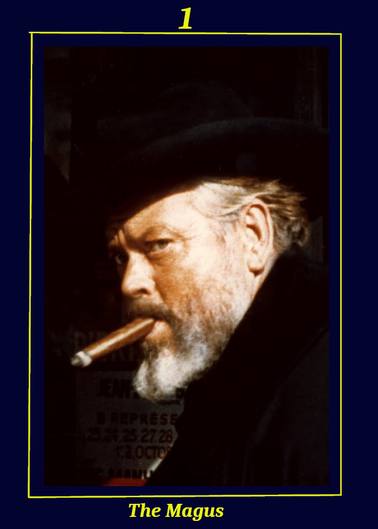 1 The first card in the Major Arcana of the Tarot Deck--not counting the zeroth card, the Fool--is The Magician. In some mystical readings of the deck he signifies control over the Four Elements, represented by the images of the four suits arranged on the table in front of him. However, as Rachel Pollack observes in her book Tarot Wisdom, earlier versions of the card show quite a different figure: not the powerful magician (or Magus, as Crowley would have it) but a common street performer, before him a set of cups for the common game of cup-and-ball. For Pollack, this historical genealogy is significant, since it points to the two-sided nature of the magician: he is a worker of wonders and he is also a trickster. To put it another way, he is both an artist and a fraud. 2 It might seem odd to begin this rumination on Orson Welles' F for Fake with a digression on the tarot, but the connection is less strained than one would expect. After all, the first sequence in this movie is Welles--immense, clad in broad-brimmed hat and a cape--performing magic tricks for a small boy. He is here the magus as trickster. And yet who can deny the wonder--the magic, perhaps--seen on the boy's face as Welles transforms a key to a coin and then back into a key, back into a coin--into a handful of coins pouring from the boy's nose into a waiting hand. Is it fakery? Of course. Both onscreen and in the editing room Welles is ultimately a showman. But it is also magic. F for Fake is ostensibly a film about Elmyr de Hory, an art forger who produced paintings so seemingly authentic that they fooled the best art critics in the West. His paintings, we are told, are still featured in unnamed museums. The film also follows de Hory's biographer, Clifford Irving, who perpetrates a fraud of his own: a biography of the famously reclusive, famously daft Howard Hughes. And the film is also in its own way a fraud; in the last twenty minutes, Welles commits a slight of hand so audacious that even now, after several viewings, it still takes my breath away. So this is a movie about fraud, about deceit. And yet, it is also about authenticity. de Hory is an authentic fraud; so, too, is Clifford Irving. So, too, in his own way, is Orson Welles, as he admits when he narrates fragments of his own biography, including the infamous War of the Worlds radio broadcast (an account that has been embellished to the point that it itself may be considered a kind of fraud). In contrast to and competition with these magnificent hucksters--each self-created in his own way, like all great artists are--Welles ranges the unseen ranks of critics, people who hold themselves up as experts on what is truly authentic and who discover, time and again, that they have been hoodwinked. In a telling observation, both Welles and Irving assert that the existence of the critic and the art market are what call into being the fraudster; the latter simply would not exist without the former. 3 The critic, in his self-appointed authority, offers the illusion of absolute certainty. J.K. Van Dover, a scholar of the detective story, titled one of his studies We Must Have Certainty. Since his study covers the history of the genre--and therefore much of the nineteenth century as well as all of the twentieth--we might take that title as the overarching theme of the past 120 years. The demand for certainty is, I fear, one that few of us escape. It is not enough to suspect a thing; we must know it, with unutterable conviction. The world of modernity (a wonderful, beautiful, horrible, and terrible world) demands solidity, not to say stolidity; if everything solid melts into air, we cling all the more to the evanescencing mist in the hope that something, anything, can hold. And into that gap steps the critic. Well-spoken, articulate, meticulous. Some of us who call ourselves critics speak from a place of knowledge, to be sure; others speak from ignorance, and therefore with more conviction. There is nothing a trickster loves more than an expert. Take a dozen sommeliers, range them in a line with blindfolds across their care-worn faces, and the trickster will substitute for their fine vintages a bottle he picked up on sale at the local grocery store. The sommelier sniffs, sips, swishes, spits, and declares that this bottle of Yellowtale Muscat is the finest French vintage he has ever encountered. His wisdom is faulty; his senses deceive him. In this film, Clifford Irving tells a similar story of fooling museum directors. When you set yourself up as an authority, you simply beg to be fooled. 4 Partway through F for Fake, Welles pauses to quote a verse from Kipling: When the flush of a newborn sun fell first on Eden's green and gold, Our father Adam sat under the Tree and scratched with a stick in the mold; And the first rude sketch that the world had seen was joy to his mighty heart, Till the Devil whispered behind the leaves: "It's pretty, but is it Art?" The poem is "The Conundrum of the Workshops." Kipling, that old imperialist sinner, knew at least enough to suggest a striking idea about original sin: that the fall of humanity (a fall seen, perhaps, in the zeroth card, the Fool) arose, not from true knowledge--a knowledge, that is, of truth and beauty--but from false judgment: it's pretty, but is it art? We might ask the same of de Hory's paintings: are these forgeries, as accomplished as they are, really communicating anything? Does a Picasso that is not by Picasso still effect us the same way (and what, we might ask, of the false Picassos painted by the actual man Picasso, referred to in the film--what occult admixture transforms a painting by the man Picasso into what we call a Picasso?) What of the film itself? Does Welles say anything in F for Fake? Does the movie have a point? It is undeniably accomplished--Welles' editing, his screen presence, his deft slight-of-hand in the final twenty minutes, are unmatched and perhaps unmatchable. It's pretty. But is it (we might ask) art? And does it matter? 5 One of the darker observations of the novel Nightmare Alley and its film adaptations is this: that people, ultimately, want to be taken in. The genius of the mentalist, of the con-man, of the fraud--of Elmyr de Hory and Clifford Irving and, yes, Orson Welles--is recognizing this fact and playing on it. We desperately want new Picassos, new Matisses, new works of art. We want the fabulous, preposterous story of Oja Kodar and her grandfather and Picasso to be true and so we will it to be true, at least for those glorious minutes before Welles, with a twinkle in his eye, reveals his deceit. What Welles seems to ask is whether it isn't better that we believe, at least for a moment, that the glamorous lie is true. Or, at least, pretend to believe. One of Slavoj Zizek's favorite stories concerns Niels Bohr who, while he was living in Copenhagen, received a visitor. While they walked around the place he was living, the guest noticed a horseshoe above a door. "What is that?" they asked. "Oh that," said Bohr. "The locals tell me this will bring good luck." The visitor was taken aback. "Why, Bohr," they said, "You are a man of science! How can you believe such rubbish?" Bohr smiled. "I don't," he said. "But they tell me it will work anyway." Bohr enjoys a particular pleasure available only to the connoisseur of fakery: he both believes and disbelieves, and so he gains the benefits of both. Ultimately, Welles leaves the question unresolved, as all questions of faith must remain unresolved. The trickster de Hory suggests that the world is made better by his trickery: that the real frauds are those who set themselves up as authorities over matters of art. And this is something that Welles seems at least mildly to condone. Because, you see, the trickster is not the darker side of the magician: he is the magician, creating through his trickery a world of possibilities undreamed of by the stolid critic. 6 Late in F for Fake, Welles takes his camera to Chartres cathedral, which he calls "a celebration to God's glory and to the dignity of man." The cathedral, by Welles' account, is an unsigned masterpiece. We do not know the names of the countless craftsmen who worked on its intricate facade; we only know the work itself, destined, if Welles is correct, to stand long after the other endeavors of humanity have crumbled into dust. Welles imagines the craftsmen of Cartres murmuring "our songs will all be silenced, but what of it? Go on singing." If Paul Tillich is correct when he says that faith is the state of being grasped by Ultimate Questions--grasped, note, by the questions rather than by the comforting assurances of the critics' answers--then the whispered words of the craftsmen of Chartres are an affirmation of faith. "I must believe," says a dying man in Welles' film, "that art itself is real. If it is not...." 7 In ancient religion, trickery was indistinguishable from piety. The oracles at Delphi plied their trade with the aid of hemp; the Elusinian mysteries depended upon a meticulous set of practices designed to induce in their initiates a sense of wonder. Allegedly--this is according to Royston Lambert in his book Beloved and God--the priests of Antinous, Hadrian's deified lover, would speak from a hollow place in the back of an immense statue of the beautiful ephebe. Trickery, all. Fraud, all. Deception--all. The modern mind rightly turns from such crass flummery. And yet who can deny the attraction of being taken in? If one could stand, momentarily, before the Delphic oracle and breath in those fumes and hear the voice of Apollo thundering forth--even if all reason cried out against the manipulation--who would not quake and know that they stood on holy ground? For faith, ultimately, is the suspension--if only temporarily--of the harshest critic of all: the one within. 8 In truth, the mystical experience or the religious experience are not limited to the baser sorts of trickery. Here is William James in The Varieties of Religious Experiences speaking of mysticism: Single words, and conjunctions of words, effects of light on land and sea, odors and musical sounds, all bring it when the mind is tuned aright. Most of us can remember the strangely moving power of passages in certain poems read when we were young, irrational doorways as they were through which the mystery of fact, the wildness and the pang of life, stole into our hearts and thrilled them. The words have now perhaps become mere polished surfaces for us; but lyric poetry and music are alive and significant only in proportion as they fetch these vague vistas of a life continuous with our own, beckoning and inviting, yet ever eluding our pursuit. We are alive or dead to the eternal inner message of the arts according as we have kept or lost this mystical susceptibility. At its fundamental level, religion is a kind of art, and therefore a kind of artifice. It seeks to produce a sensation, a sense of oceanic wonder, a connection to divinity. The magician who opens the door to that divinity is also a trickster. Perhaps, we might suggest, the divinity is itself a trickster as well. By sheer coincidence, I was reminded as I sat to write these words of a quote from Edgar Allan Poe's "The Purloined Letter": "Not altogether a fool," said G., "but then he's a poet, which I take to be only one remove from a fool." Poe--himself a poet, himself a trickster--touches upon a fundamental truth here: that foolishness is the gateway to wisdom. The zeroth card--the fool card, only one step before the magician (that is, the poet)--takes a step forward, his eyes lifted to the sky, not seeing the cliff before him. He is about to fall. And when he does, he will progress through the Major Arcana until he finally finds himself complete again with card 21, the World card. And back again, since in some decks the zeroth card is the end, rather than the beginning, of the Major Arcana. It is a terrifying thing, this willingness to be fooled. But it is the central demand of art, of poetry--of religion. And, as F for Fake shows us, even knowing the trick (knowing, for instance, that the moment Welles starts insisting that a story is true we can be certain that it is a lie) does not rob it of its power. 9 "And what," I hear my longsuffering reader ask, "Has any of this to do with faith?" Perhaps, depending on your faith, nothing. Or perhaps everything. Art is faith made manifest: Faulkner's one puny inexhaustible voice, still talking. We sing on in uncertainty; we sing on, perhaps, because of uncertainty. If you are feeling at this point a tormenting uncertainty, it's one that I feel as well (and one that I suspect Welles both expects and delights in): isn't this a demand to give up reason (and Reason), to surrender critical thinking, to plunge into the dark superstitious miasma that characterizes crystal readers, palmisters, cartologists, astrologists, Q-Anoners, and faith healers? "Ah ha," says Welles. "But don't you see that's the point? The mistake the card-readers and the Q-Anoners make is that they mistake their faith for reason. Faith, in the end, must be a kind of play." The very act of enjoying art is an act of faith. Indeed, artistic appreciation is indistinguishable from it. 10 A final quote. This is William Shakespeare's ineffable flim-flam man Prospero: Our revels now are ended. These our actors, As I foretold you, were all spirits, and Are melted into air, into thin air: And, like the baseless fabric of this vision, The cloud-capp’d towers, the gorgeous palaces, The solemn temples, the great globe itself, Yea, all which it inherit, shall dissolve, And, like this insubstantial pageant faded, Leave not a rack behind. We are such stuff As dreams are made on; and our little life Is rounded with a sleep. Sir, I am vex’d; Bear with my weakness; my old brain is troubled: Be not disturb’d with my infirmity: If you be pleased, retire into my cell, And there repose: a turn or two I’ll walk, To still my beating mind. Long ago, critics took this to be Shakespeare's own farewell to the stage. Whether that is the case or not, it is a suggestive note on which to end. Since Indiana Jones and the Dial of Destiny is out soon and will be the (allegedly) final entry in the Indiana Jones series, I took some time this week to rewatch the four previous movies. I started to say "authentic" movies, since Dial only features one of the three driving forces of the series, but I didn't want to be pre-emptively churlish. Certainly, the trailers for the new movie look fine and I'm sure it'll have its own charms. But, like Star Wars, Indiana Jones is such a creator-driven series that any new entries can only be a coda, an homage. These are the four authentic Jones movies, featuring Spielberg and Lucas working behind the camera and Harrison Ford in front of it. And they're great. Let me be clear before I begin: even the worst Indiana Jones movie is better than any of the series' imitators. So this ranking--wholly objective and correct as it may be--should be taken in that spirit. My own choice for "worst" features inventive action, memorable jokes, and a reasonably brisk pace. That is to say, it's top-tier action-adventure and would be the best entry in almost any other franchise. That said, there can be only one best Indiana Jones movie, and the answer to that is clear. Raiders of the Lost Ark (1981) All of the other Jones movies are great, but this one is a masterpiece. Indiana Jones emerges fully-formed as a character in the opening sequence: the mixture of seeming competence and profound incompetence, the iconic profile, the whip.... It's all there in the first fifteen minutes. Ford is splendid in the role, turning in a comedic performance that never becomes too broad. And as the movie progresses (relentlessly--this is one of the least-flabby action movies imaginable), layers build up. His relationship with Marion, his relationship with Belloq, with Sullah, all of these feel lived-in and authentic. Really, I can't say much about this movie without gushing. It's an absolute masterpiece and belongs in the Olympus where we keep the truly great movies. No other movie in the series comes close; at best, they're all about on a level--very, very good. But not eternal. So, in that spirit.... Indiana Jones and the Kingdom of the Crystal Skull (2008) Spare me the gripes about aliens and vine-swinging bikers. This movie's more fun than you can legally have in some states on a Saturday night. Ford ages up his character, giving him heft and gravitas while keeping the hapless core. Mutt Williams is a great addition to the series, reflecting the father-son dynamic from Last Crusade but doing it better. And Marion's back, which counts for a lot. The central trick here is that Indiana Jones exists in movie-land (incidentally, that's why sight-gags like the invisible bridge in Last Crusade and the magically-appearing baddies in both this film and Temple of Doom work; no one in the Indiana Jones films has binocular vision). The original three were homages to serials of the 1930s, but this one--because it takes place in the 1950s--has to engage with a later decade of pop culture. So we get Soviets, the Bomb, and aliens (interdimensional beings, in point of fact). The look is accordingly updated; it feels, often, like a technicolor adventure flick from the 1950s rather than a grittier affair. This is all very wise and pushes the series forward rather than wallowing in nostalgia. Where the movie falls flat isn't the setting or the aliens or the vine-swinging. It's the climax. Crystal Skull--like Last Crusade--learned all the wrong lessons from the first movie. Both films think that a central draw of Indiana Jones is the puzzle-solving, figuring out the ancient traps, and so on. And, yeah, that's part of it; Raiders works so well because it grabs viewers with that initial set of preposterous traps and then drags them along. But central to Raiders is the fact that, ultimately, everything that happens is out of Indiana's control. The more he tries to control things, the worse they get. It's only when he closes his eyes and lets things happen that the situation resolves itself. Last Crusade and Crystal Skull both drop the ball; they do equally focus on the idea of letting go (literally, in the case of Last Crusade), but they clutter up the climax with the kind of puzzle-solving and decoding that Raiders wisely kept to the beginning and middle of the story. The climax is also too cluttered with characters. As much as I enjoy every individual one of them, having Indiana, Marion, Mutt, Ox, and Mac all standing around for the big scene means that no one of them gets the chance to really shine. Still and all, this is a fantastic movie--a great ending to a great series. Indiana Jones and the Temple of Doom (1984) Hoo boy. I specialize in midcentury American literature, so having problematic faves goes with the territory. But this one's probably the most problematic favorite thing I have out of any media, ever. Because, to be frank, it's really, really racist. I don't think it's intentionally so, not that that matters so much; it's not Birth of a Nation or anything. But it regurgitates so many aspects of the serials it is aping, unthinkingly and without any attempt to subvert or interrogate them, that it winds up just playing straight such ideas as: colonized people can't govern themselves; colonized people are barbarians who need to be "civilized"; you can't trust a "civilized" person from a colonized nation; etc etc etc. If you've seen it you know what I mean; the British literally show up with a cavalry to save the day at the last moment. Kipling probably shed a single happy tear in whatever hell he's in. That is all--let me be very unambiguous about this--very bad. It's only marginally less bad if you take for granted that (again) the Indiana Jones movies take place in movie-world rather than our own world. And, no, deleted scenes where the Good British Man observes that real Indian people don't eat chilled monkey brains don't cut it. Neither does some kind of hand-waving about how this is really a bad cult and the good Indian people don't go along with it. Because, y'know, that's colonialist talk. So. Not fantastic. And the really unfortunate thing is that (unlike Birth of a Nation), this movie--in the midst of all that--is kind of great. The first two-thirds play like a screwball comedy, with Indiana sparring with Willie Scott. And then it veers, quite abruptly, into a horror-adventure, with heart-ripping and zombie juice and, frankly, all the things that make this kind of movie enjoyable. That's a bold swing; both of these aspects are either muted or wholly absent in Raiders. Temple of Doom does what every good second film in a series should do: it changes things up, explores new avenues, tries new things. And it mostly succeeds. Willie is no Marion, but Kate Capshaw is very funny in the role. Ke Huy Quan is great as Short Round, bringing us the best sidekick in the series. And Harrison Ford is in his prime as Indy; the sequence where he's drugged and shirtless have surely danced across countless dreaming eyelids over the past decades. Indiana Jones and the Last Crusade (1989) Sigh. I know, I know. "But it has Sean Connery!" Listen, I like this movie. It's probably the movie I quote the most with my friends. It's got Sean Connery. It's got Sullah back. It has Marcus Brody. I know, I know. It's just.... The whole affair is so tired. The movie's a retread of Raiders of the Lost Ark but without the nasty streak that makes that movie so entertaining. This is a safe Indiana Jones, a domesticated Indiana Jones (no wonder so many of us who love it have fond memories of watching it as children). The performances are entertaining but toothless; the climax is overburdened and underbaked just like Crystal Skull would be years later. Basically, you can tell that everyone involved just wanted to get the third contracted movie out of the way so they could move on with their lives. See? I sound like I hate it. And I don't. It's fine. It's better than any of its imitators. But next to the other two sequels to Raiders it's tame, unambitious. But let me say something nice about. The dialogue is great. Apparently Tom Stoppard did a polish on it and it really works very well. Like I say, of all the Indiana Jones movies, this is the one I quote the most, even if it's the one I revisit the least. So that's that. The absolutely and inarguably definitive ranking of the Indiana Jones movies. I've not watched all of the Young Indiana Jones Chronicles, so I'll not even touch on where they sit relative to the main line of movies.
Now that's sorted, we can figure out soon where Dial of Destiny fits. Initial reviews aren't great, but who knows. What we do know is that, with the original four, Spielberg, Lucas, and Ford are responsible for one masterpiece and three great sequels to it. And that's nothing to sneeze at. 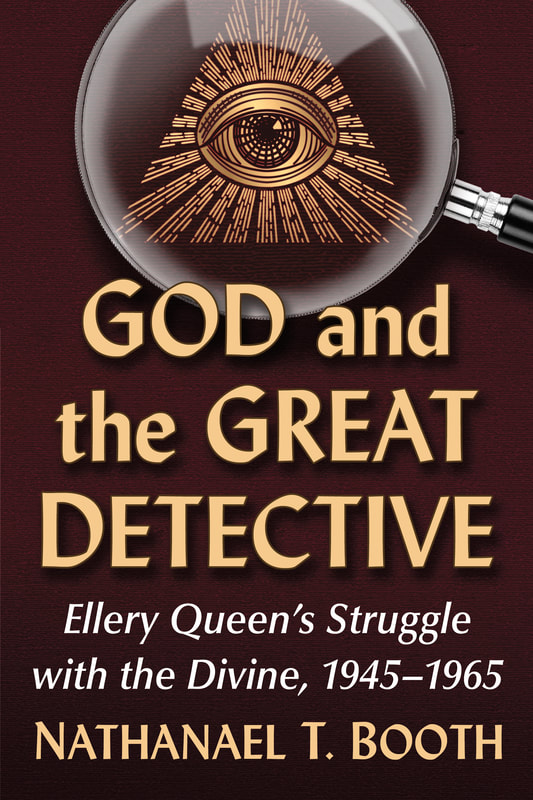 Not much to say here; I'm in the middle of the last week of classes here, and it's hard to keep up with everything. But I wanted to update and say that here's a high resolution version of my book cover. I've also got bookmarks and flyers, and will try somehow to make those available soon. Meanwhile, if you want a copy just email me!
1. These are undigested notes coming fast on the heels of me finishing my third or fourth rewatch of the original run of Twin Peaks.
2. Conventional wisdom says that season 2 of Twin Peaks is the bad season. This is certainly an impression that David Lynch is happy to support--he was barely active in the second half of the season, after Laura's killer was revealed. I'm not so sure it's accurate, though, for a couple of reasons. One is that, as I see it, there's only about four bad episodes in the second season. That's a hefty number but it isn't unusual; your average season of Star Trek has more duds. Now, these bad episodes are bad. These are the episodes where James goes off and gets involved in a pastel noir and Ben Horne goes slightly mad and thinks he's Robert E. Lee. There's not really anything redemptive that can be said about these interludes. 3. On the other hand, lots of things that I've seen pointed out as "bad" really aren't. Super Nadine is goofy, but it's fine. Heather Graham has a certain dry humor about her that matches well with Kyle MacLachlan. Billy Zane acts like he's wandered in out of another show, mumbling his way through the episodes; it's charming. The Windom Earle plotline isn't great, but it's hardly an abomination. 4. Oh, yes. The second half of season two introduces Denise Bryson, who is objectively one of the best things about the show. 5. Now, this isn't to say that season 2 is nearly to the level of season 1 (or, more accurately, that the post-reveal series is to the level of the pre-reveal series). But it isn't for the reason a lot of people, including David Lynch, suggest. Lynch is convinced that the death of Laura was the engine of the series and that removing the mystery destroyed the show. And perhaps he's right. But the precise way that works is less concrete than "they killed the mystery." Put simply--Twin Peaks without the Laura Palmer mystery is less nasty. Twin Peaks pre-reveal is a thick stew of sex, incest, abuse. There's not really a morally pure character here; even Pete has his cruel streak. After the reveal, the town cleans up. To take one obvious example, Ben Horne--the abusive sexual predator (remember, he had a relationship with the teenage Laura for *years*)--drops his cigars and starts trying to be a good person (a plotline revisited, to greater success, in The Return). The evil at the heart of the town becomes mere eccentricity. I think this is why Windom Earle comes off as a cartoon: he's an outside parody of an evil villain rather than an internal reality. 6. Because if BOB is "the evil that men do," that means that he's really Twin Peaks itself. Much like the creature in Stephen King's IT is foundational to the community it terrorizes, so BOB is the outgrowth of all the horrors committed by the people in this small town. 7. I would like to make a paradoxical suggestion, though. If the reveal led to a lightening of the darker elements of Twin Peaks, Lynch is wrong that it killed the show. In fact, there's an important sense in which Twin Peaks could only be itself once the revelation had been made. This is literal in the sense that Lynch, when he got the opportunity to make a movie, chose to return the focus to Laura Palmer, making a prequel (apparently against the wishes of co-creator Mark Frost). But there's a deeper sense in which this is true. As long as the truth of Laura's killer remained a secret, the show couldn't really be about the thing it's really about, which is not only abuse (and not only Lynch's favorite theme of women in trouble) but about abuse within the nuclear family. 8. I've not said it in so many words, partly because I assume anyone who's read this far knows it, but Laura Palmer is murdered by her father after years of sexual abuse. I've written about the centrality of incest to American small-town narratives, so if you want more of my thoughts on this--better-developed and copyedited--check out my book. Laura Palmer is a lot of things, but one thing is an heir to a whole line of girls abused by their fathers. The ur-text, by my estimation, is Henry Bellamann's Kings Row. Closely on its heels follows Grace Metalious's Peyton Place. In both of these novels an important plotline is precisely the abuse of a young girl by her father (or stepfather in Peyton Place, a choice forced on Metalious by her publisher). Laura Palmer is directly in this line. However, she's different in an important way: while the abused girls in the two older works are side characters whose stories are designed to reflect or influence the protagonists' journeys, Laura is (as Margaret Lanterman would say) "the one." Her spectral presence guides the entire narrative. 9. But here's what's important here: until we know the truth of Laura's murder, we can't really see what the show's doing. We can guess, we can intuit, but we can't put it in so many words: that the central evil haunting the small town of Twin Peaks is abuse within the nuclear family. That the very structure that seems to promise stability and morality is itself the origin of all the evils it claims to oppose. This is an important observation, and one that can be extended upward; insofar as the nuclear family is conceived of as a mirror to the town, and the town as the mirror to the country (this is the core thesis of my book), we have to say that Twin Peaks is making larger claims about America itself--that it generates the very evils it fights. Such an argument would take more time to develop than I have here. 10. This is what I mean when I say that Twin Peaks could not be Twin Peaks until it was "killed" by revealing that Leland Palmer murdered his daughter. The revelation forces the story finally to be upfront about its central thesis. Everything afterward becomes a working-out of this central thesis, from the remarkable Fire Walk With Me to the astounding third season. I think it would not be an overstatement to say that, had Lynch and Frost gotten their wish, the show would never have been able to live up to the potential of the first season-and-a-half. I've got a big thing on F for Fake (kind of) that I want to post soon, but I'm waiting for my blurb at the Arts and Faith website to go up.
Incidentally, check out the Arts and Faith Top 25 Spiritually Significant Documentaries list. It's a good list, compiled by a small group of critics and viewers, of whom I am one. I wanted to do a quick post about Succession. This thing is going to be spoilery and half-baked, so be warned. Man, what a finale, right? I don't think I've been this satisfied by a series finale since Twin Peaks ended. Everything came together so satisfyingly, so inevitably. A quick note on reception, which I might develop at more length later in some way. I've seen Succession compared to Shakespearean tragedy, but that doesn't seem quite right to me. Succession isn't a tragedy--in spite of what people keep saying online--it's a satire. This difference is key. Put very simply. in tragedy, the tragic hero is better than we are in some way: Hamlet is more thoughtful, Lear more regal, Macbeth more noble, and so on. They're undone by an inner flaw, but that flaw is in some ways a reflection of what makes them great. Think poor mad Captain Ahab, whose flaw (madness, hubris) is of the same stuff as his grandeur. With the possible exception of Logan, none of these characters are great in this way. They aren't magnificent people whose flaw arises from their magnificence; they are all flaw, all failure. If we bring Shakespeare into this at all, we have to say that this is a Shakespearean plot populated by idiots. Kendall might think he's Hamlet, but he's barely a Prufrock (and at least Prufrock had the self-awareness to know that he was no Prince Hamlet). And that's satire. So when Kendall ends up sitting on the riverside, he's not a grand figure brought low--he's a low figure who's returned to his proper level. The same could be said of Shiv or of Roman. The fact that an empty suit is elevated to the throne at the end simply puts a cherry on top: the prize they were seeking was always a nonsense role that can be filled by the most craven person in the main cast. Is there hope for these people? Jeremy Strong certainly doesn't think there's any for Kendall, as he observes in the show's official podcast. Me, I'm not so sure. There certainly doesn't need to be any hope for them. They're bad people and they're getting to live their lives in spiritual (though not material) destitution. They're reaping what they sow. Again, that's kind of the satiric point. And yet there's a couple of points here that give me pause: 1. Strong tells a story of texting Jesse Armstrong after watching the episode and receiving back a line from The Waste Land: "Entering the whirlpool." It's a line from "Death by Water": Phlebas the Phoenician, a fortnight dead, Forgot the cry of gulls, and the deep sea swell And the profit and loss. A current under sea Picked his bones in whispers. As he rose and fell He passed the stages of his age and youth Entering the whirlpool. Gentile or Jew O you who turn the wheel and look to windward, Consider Phlebas, who was once handsome and tall as you. Now, I'm not going to do my Waste Land schtick again, but this is very interesting to me for a couple of reasons. One is that the whirlpool here is clearly tied to the Wheel of Fortune: Phlebas is on a cycle, recapitulating his life. This of course relates to the way the characters here are stuck in a cycle, but there's an implicit suggestion of rebirth here. So could Kendall rise again? Maybe. Or maybe not. The key here is that he's left in a state of uncertainty: things could go either way. 2. Speaking of uncertainty, our favorite neo-nazi slimepuppy Roman Roy has a moment of unexpected clarity in this episode when he says that he, Kendall, and Shiv--and indeed all their ways and ends--are "bullshit." Now, I want to consider this observation from two angles. First, the obvious one: he's recognizing that they, these characters, are shallow, facile people who were never up to the grand Shakespearean stakes that they thought they saw in their struggle. That is, he's recognizing that they are in a satire, not a tragedy. It's a moment of self-awareness that has been present in his performance over the past four seasons, but its positioning here is significant. Roman has always been the most self-aware of the siblings, though that self-awareness is undercut by a failure to see beyond itself: it's unselfaware about its own limitations as self-awareness (which is what makes Roman such an easy mark for fascism). But on a little lower layer, there's something almost...I don't want to say "Zen" here because it feels shallow...there's something profound about this character facing his own inner nothingness at this point. These characters have been brought to a place where self-acknowledgement is possible. Or, perhaps, not-self acknowledgment: a recognition that they are fundamentally nothing, essentially nothing. This is a scary recognition, but it's one that's essential for any sort of peace. These characters have no essential nature; though Kendall insists that he can only do one thing, that self-image is an illusion. And if they can break free of that illusion, they may be able to break the cycle. Incidentally, my reading this year has me digging more into the Tarot, and I do associate Roman with The Fool, which is a card of pure potentiality and also of nothingness (it is the zeroth card, after all). 3. Finally, there's Shiv. I love Shiv. I love her and Tom together--they are absolutely unhealthy and also absolutely scintillating. And she's important, because her choice is the one that ultimately determines the resolution. So where is she at the end of the show? Well--like her brothers, she's been reduced to nothing. As others have observed, she's almost certainly still richer than her husband; the "power dynamics" here have not been so much reversed as complicated. Her diminishment is one of ego, not pure power. I don't mean "ego" pejoratively. After struggling for all these seasons to make her way as a woman in a man's world, Shiv has lost the fight. And that's devastating. She is not a trophy wife, but she's been absolutely shut out of the company (for now, anyway). The final shot of her and Tom in the car is rife with irony and ambiguity: she stays with him though she does not need him. But she will not clasp his hand (nor he hers). They are not a partnership. They're...something else. But of course potential is there. We know that in spite of their unhealthy power-plays that each of them feel something for the other. Based on Sarah Snook's performance, I do believe that she really loves Tom (in whatever twisted way the Roys can love anyone); and Tom loved (at least) her. Again, they're bound to this cycle of illusion, but there's a potential there to break the cycle if they can only stop and see themselves for the bullshit they are. (On a ground-level-dumb observational note, see that Shiv is still pregnant at the end of the series. If we assume that pregnancies in literature are symbolic of new life, new beginnings, then Shiv carries within herself a future that has not yet been born. What that would look like is up for grabs: not only does she come from a terribly abusive family; not only is she married to a man with whom the dynamic is fundamentally unhealthy; but mere episodes ago we saw her drinking alcohol, raising the possibility that she's poisoned this new world even before it was born. But the point is that we don't know: the baby is pure potential). Now. I'm not saying that this ending is hopeful. It's ambiguous, which is the point. On a literal level, based on everything we've seen, there's no reason to believe these characters will do anything different than they've done all this time. Kendall will sink lower and lower; having finally and totally lost the one thing that gives him meaning, he'll enter the whirlpool. Roman will probably go full fash. Shiv will keep futilely trying to assert herself in a system that hates her, seeking a prize that would never satisfy her. But. Much as I suggest in the Nightmare Alley episode of The Projectionist's Lending Library, the literal likelihood of a character suffering the worst possible fate doesn't really negate the fact that at this point, at the end of the narrative, they are left in a state of potential. And that's precisely what gives the finale its charge. Hope might be faint, but it's there. I've enjoyed Succession since I started watching it, but this season has confirmed for me that it's one of the greats. I look forward to revisiting it many times in the future. I just finished teaching four weeks on The Waste Land. I usually try to mix up my texts from year to year, but one thing I've kept consistent is that I've taught this poem every year. And every year I discover new things in it as I shift focus from class to class. This year, my big revelation involved this section from "What the Thunder Said":
Who is the third who walks always beside you? When I count, there are only you and I together But when I look ahead up the white road There is always another one walking beside you Gliding wrapt in a brown mantle, hooded I do not know whether a man or a woman —But who is that on the other side of you? So without any attempt to be systematic or even particularly insightful, here's some notes on this passage. 1. Eliot tells us in his notes that this section is partially indebted to the encounter of the disciples with the risen Christ on the road to Emmaus. Here at the end of the poem Eliot is preparing us to finally encounter the Hanging Man who was missing from Madame Sosostris's deck--a figure of renewal for Eliot, associated with dying-and-rising gods such as Osiris, Dionysus, and Jesus. 2. A telling difference here is that Eliot's risen god is spectral. In the Lukan account, Jesus walks and talks and breaks bread with the two disciples. He's physically risen and physically interacting with them. But in Eliot, the risen god can't even be seen directly. When the speaker counts (looking to his companion) he only numbers two on the road. It is only when he looks ahead that he sees "another one." Which is to say--the figure appears in his peripheral vision. It cannot be looked at, only glimpsed. 3. Another feature of this spectral redeemer is that they are androgynous. Eliot's speaker says "I do not know whether [they are] a man or a woman." Now, I've read this poem many times over the past sixteen or more years, and I'm not sure I've ever fully taken in what the speaker is saying here. The Waste Land is, among other things, about gender; Eliot even suggests that Tiresias, the prophet who transitions between genders (multiple times!) is the key figure in the poem. Now, Tiresias possesses the sexual characteristics, seemingly, of both genders ("old man with wrinkled female breasts"). This spectral redeemer isn't quite that, but they do exist in a kind of in-between space, neither man nor woman. I'm not quite certain what to make of this, but it seems to me now that Tiresias and this figure have a fundamental unity--not as strong, perhaps, as that between the merchant and the Phoenician sailor, but there all the same. 4. I want to make some sort of connection, too, between Tiresias and the Divine Hermaphrodite that some people see in the World card in Tarot, but there's something holding me back: namely, that Tiresias doesn't represent unity or renewal. On the other hand, this phantom savior does--one way of reading the final words of the poem is that Eliot posits a healing of fracture through union. As I say, I don't mean to do anything here except lay out some very basic thoughts that have occurred to me through this most recent reading of the poem. The Waste Land is a tremendously rich text and always surprises me every time I return to it. One day I might even understand it. Today I'm just making a quick post on what I'm watching (or, in some cases, re-watching). Two new, two rewatches:
1. Succession. Look, everyone is watching Succession. Or, at least, so it seems. And they should, because it's really good. Great, even--and I mean Great with a big G. I probably wouldn't have said that a season ago; I liked it a lot, but I wasn't ready to say that it's a permanent work. But now? Absolutely. The run of episodes starting with Logan's death and running through his funeral are all a step above anything the show's done before. I'm not sure I've ever seen on television a sequence as rending as the death episode. It brought back some bad old memories of my mother's death and the numbness and disbelief that attends such an event. And when you follow that with the next episodes--the extreme emotional violence of the Shiv-Tom argument on the balcony, an argument so intense that you almost wish they would do something physically violent just to break the tension--the election-night episode with its echoes of 2016--the funeral where self-interest and mourning blend in strange and magical ways.... It's just a fantastic show and one that I expect will maintain a following long after the finale drops. 2. Oh, No! Here Comes Trouble! This one's an odd one. I'll just give a summary here from MyDramaList: Pu Yi Yong is a typical high school student. When he unexpectedly gains superpowers after waking up from a car accident, his previously uneventful life is suddenly not so ordinary anymore. This summary doesn't do the show justice. Neither does the English title, which is goofy and doesn't at all convey the mixture of genuine human emotion and silliness that characterizes the show. The protagonist here can see dead people and help them through the power of...traditional Chinese calligraphy. It's an odd little idea, but one that I vibe with. I just finished teaching The Waste Land for the semester, and one of the things I continue to adore about that poem is the hope at the end that, somehow, the poet can make a broken world whole. There's something of that in this show as well. Also something of Alan Moore's contention that artwork is a kind of magicwork. I wouldn't say this show is either Great or great, but it's charming and intriguing. 3. Atlanta I watched the first two seasons of Atlanta some time back, but frankly I found the second season so anxiety-inducing that I gave it up. That's not a judgment on the show; I would have been watching it around 2019/2020 and those were stressful years for everyone. I decided to give it another go, so now I'm halfway through season 1 again. The really weird stuff hasn't kicked in yet, but I'm enjoying the humor and the streaks of absurdism woven through it. 4. Twin Peaks I love this show. Obviously, I've watched it several times before, and I frankly don't know if I can ever write about it in a way that really conveys how I feel about it. Season 1 is obviously solid, but season 2 is good, too, in spite of its reputation. I do think that this rewatch convinces me more than ever that certain multi-hour videos about how it's all really about television are...not only wrong, but absurdly wrong. It's a show about a lot of things: Lynch/Frost's own peculiar metaphysics, violence against women, the hypocrisy of American mythology. It might even be partly about television. But anyone who says it's really, really about television is high on their own supply. Maybe I'll have more to say when I finish this rewatch. |
AuthorNathanael T. Booth. All views are my own. Archives
April 2024
Categories |
 RSS Feed
